- Datapunkt Intelligence
- Hits: 284
Source Catalog Agent
In today’s technological landscape, data is everywhere – beeping and squeaking from multiple sources, in different types and formats. Databases, streams, files, PDFs – modern companies certainly don’t lack data. What they lack is an understanding of it.
What is stored where, what that data looks like, and what it actually represents – building such an inventory is typically a troublesome, manual task. Our dedicated agent is here to lift this burden off your shoulders.
In this article, we explore the Source Catalog Agent – a smart digital librarian and a source-agnostic schema expert. We’ll look at its core functions, the business value it delivers, and what makes it a real asset in modern data environments.
What Is the Source Catalog Agent?
The Source Catalog Agent is an autonomous software agent that automates data discovery and maintains a living catalog of identified datasets. Within Datapunkt's ecosystem of agents, it is the first brain that touches your data before it can be modeled, transformed or analyzed.
What kind of information does it uncover?
- Data location and source structure. What databases, streams, files, or documents exist across the organization? What schemas do they have? What lives in SQL systems, in Kafka streams, or PDFs?
- Data shape, quality, and freshness. How is data structured across these sources? Which data types are used? How are values distributed? How fresh and reliable is that data?
- Data meaning and business context. How does the business context align with schemas and fields?
Discovery and Metadata
Today, as data landscapes grow amazingly fast, organizations often lose a clear view of what data they actually have. New sources silently appear, and metadata becomes outdated faster than documentation keeps up. As a result, teams are left asking questions like: Does this dataset already exist? Is anyone using it? Is it still valid?
Beyond being frustrating, this situation can quickly become operationally dangerous: working with outdated datasets and partial context could end up with decisions based on assumptions, not facts.
The Source Catalog Agent addresses this challenge by continuously discovering data sources and maintaining their metadata inventory. The agent connects to systems via dedicated connectors and scans tables, columns, and data types; it figures out how things relate, and writes all of that down in a centralized catalog. The catalog is automatically updated with every discovery run.
The result? You no longer need to manually document schemas anymore. The agent generates data about your data – clearly described, consistently structured, and always current.
The diagram below displays how the Source Catalog Agent turns distributed metadata into a standardized output.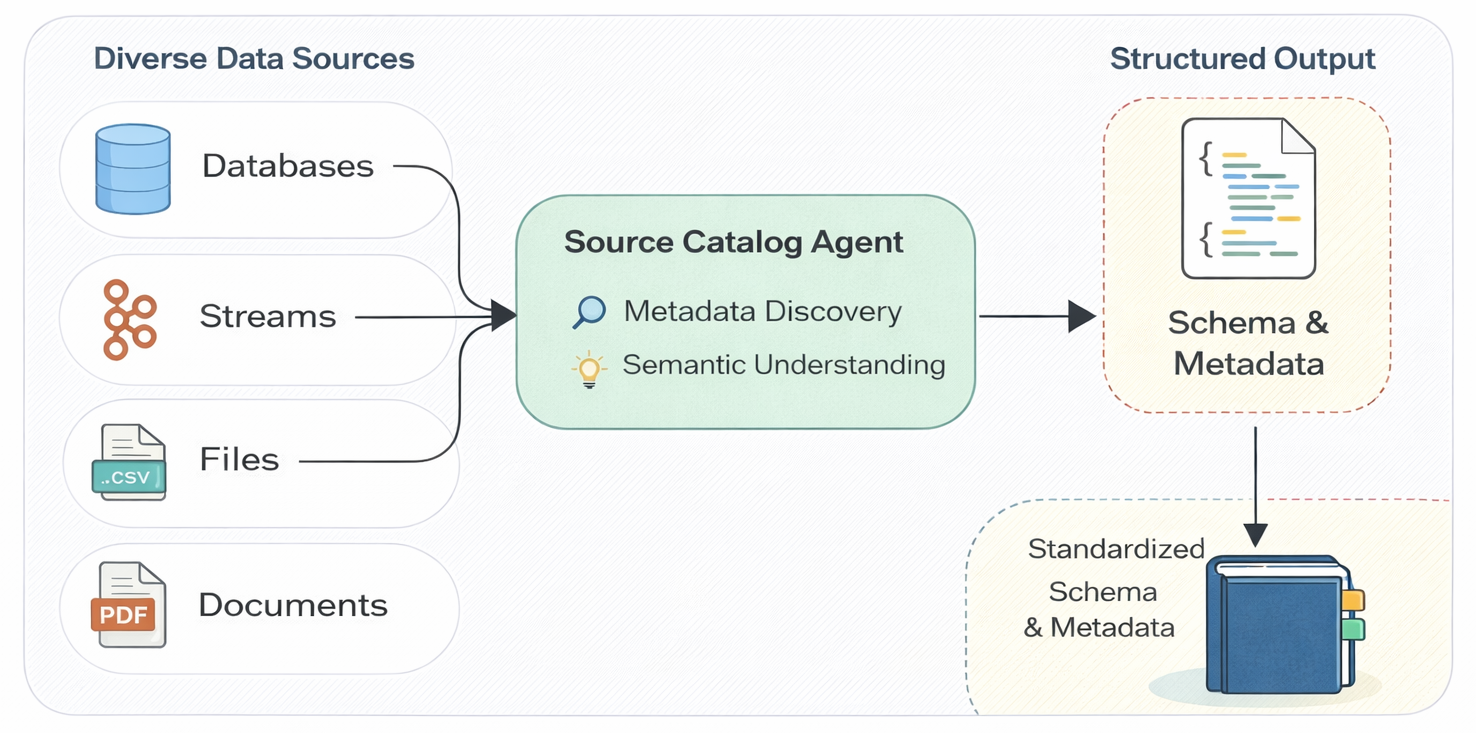
Universal Connectivity
Modern operational environments often include multiple, diverse data sources. As data accumulates and spreads across these systems, it creates an operational challenge: how to extract this information and make it understandable in a consistent way?
Imagine three sources, each identifying customers using a unique identifier:
- SQL table:
customer_id - Kafka stream: "
custId" - PDF spec: “Client Identifier”
The same concept is expressed differently. To a human, these are obviously the same thing. To systems, however, they are not.
The Source Catalog Agent recognizes such variations and understands that they refer to the same underlying concept. It connects to different systems through a unified interface, exploring and cataloging data regardless of where it resides — in structured databases, streaming platforms, or unstructured storage. From the agent’s perspective, these systems become part of one coherent data ecosystem, connected at the level of metadata and meaning.
So instead of having multiple tools for different data types, you can use one agent that understands all of them.
Contextual Schema Logic
You have probably come across situations where different teams interpret the same data in different ways. This discrepancy may start with something as innocent as the customer_status column: an engineer understands it as an enabled account; an analyst, as an indicator of recent activity; and the business sees it as paying customers. Without shared context, the same field silently drives three different interpretations – and three different decisions.
The Source Catalog Agent prevents this semantic drift by enforcing a consistent interpretation of entities across teams. It ingests contextual knowledge from documentation, specifications, and business definitions to accurately align technical fields with business intent. As a result, data engineers, analysts, and business users are talking about the same things – not three different interpretations of the same column.
Core Capabilities of the Source Catalog Agent
Creation of a master schema for data sources. The agent generates machine-readable schemas that serve as the official technical source of truth for downstream systems.
Intelligent data profiling. The agent analyzes value distributions, nulls, and outliers to assess data quality and detect anomalies early – helping prevent issues before pipelines break.
Context-aware cataloging. By incorporating business context and domain-specific knowledge, the agent creates a common semantic layer across different teams that work with the same data.
Up-to-date metadata inventory. The agent maintains a living catalog of discovered datasets and automatically refreshes it with every run.
Universal source connectivity. With broad connectivity options across structured, streaming, and unstructured sources, the agent acts as a single entry point into the data ecosystem – all through one unified interface.
Semantic relationship mapping. The agent identifies relationships between entities and represents them in a semantic map, making connections explicit and reusable for downstream systems.
Security. The agent operates on metadata only and does not process the underlying data itself. This design makes it well suited for regulatory or security-sensitive organizations.
Conclusion
Before data can be transformed, modeled or acted upon, it needs to be understood. The Source Catalog Agent provides that understanding by discovering data sources and connecting them into a coherent semantic layer. By making data discoverable, contextual, and semantically aligned, the agent creates a trustful foundation for downstream systems to build upon.